

A case study with Merit’s FATE Program
At a Glance
- Organization
- Give Merit, Inc. (DBA Merit)
- Program
- FATE Program, Detroit
- The work
- A 10-year youth development journey, from 9th grade into early adulthood
- The engagement
- Evaluation and learning framework design, 2026
- What we built together
- A 10-year theory of change, learning priorities and evaluation questions, a developmental measurement strategy, updated surveys and focus group protocols, and structures for staff reflection and sensemaking
- The shift
- From annual snapshots analyzed by outside consultants to an evaluation system Merit uses to learn across the full FATE journey.
Many organizations doing long-term, relational work find themselves in the same bind. They collect plenty of data, but it arrives as a series of annual snapshots that never quite add up to a holistic story of growth.
The Challenge
A decade-long journey, measured one year at a time
Merit’s FATE Program has walked alongside Detroit youth since 2012, supporting them through a 10-year journey from 9th grade through post-secondary education and into early adulthood. FATE’s model rests on something fundamental about youth development: growth doesn’t happen all at once or in a straight line. What a young person needs and navigates at 14 looks different at 18, and different again at 24.
Merit was collecting a lot of information, especially during the FATE high school years: annual student surveys and focus groups, plus perspectives from caregivers and mentors. But survey results came back as dashboards of individual questions from one consultant, and focus groups were summarized into themes by another. Because FATE was transitioning to a new framework, neither was yet consistently connected to the updated outcomes framework or to each other.
Merit could see what students said in a given year. It was much harder to see how a FATE cohort was developing over time, which changes were meaningful, or what evidence together suggested about FATE’s contribution.
The challenge wasn’t a lack of data or commitment. It was an evaluation system that couldn’t yet match the length and ambition of the work.
The Key Insight
Growth doesn’t follow the calendar
Merit came to Illuminary Perspectives in early 2026 with a clear goal: to understand and communicate student growth across the full 10-year FATE journey. Aligning its surveys and focus group tools with its new outcomes framework was an important part of that. But before deciding what to measure and when, we needed to answer a bigger question together: how does Merit expect growth to unfold across a decade of the FATE Program?
We developed a 10-year theory of change organized around four developmental stages: early adolescence, late adolescence, emerging adulthood, and early adulthood. Mapping the FATE Program’s outcomes across these stages made something clear. Not every outcome needed to be measured with the same intensity every year, and growth doesn’t always look like a steady upward line.
The move out of high school made this especially visible. Graduates leave the structure of school and of weekly FATE programming, and step into college, work, and adult life with more independence and fewer built-in supports. A plateau, or even an apparent “backslide,” on some outcomes may not mean a young person has stopped growing. It may mean the skills they built are now being tested in a harder context. Knowing the developmental context changes how the data should be read.
If you work with people over a long period of time, your evaluation should evolve with them.
Our Approach
Measure with intention, not just frequency
Rather than measuring every outcome every year because it was possible, we designed a strategy that concentrates attention where each outcome matters most.
A longitudinal survey anchors key moments: program entry as a baseline, high school graduation as a major transition, and Year 8 for longer-term development. A Year 10 survey looks beyond the core outcomes toward the FATE Program’s broader vision. In between, shorter pulse surveys focus on the outcomes more relevant at each stage, and student and alumni focus groups are tailored to what young people are navigating at that point. Caregiver surveys, a senior-year caregiver focus group, mentor surveys, and new staff reflection forms add further perspectives.
Just as important, the framework goes beyond data collection. It includes guidance for bringing evidence together, connecting it back to shared evaluation questions, strengthening reporting, creating feedback loops, and revisiting the framework itself over time.
More data doesn’t create more learning. Intention does.
Building It Together
Starting with what FATE already knew
This framework wasn’t built for the FATE Program and handed over. Through regular conversations with Merit’s Program Success Director, we reviewed emerging ideas, pressure-tested assumptions, and translated the team’s deep knowledge into a practical system.
Co-creation sessions brought Merit’s leadership and FATE program directors in at key moments. We didn’t start with measures. We started with what the team already knew: what young people experience across the 10 years, where the important transitions happen, and how expectations for growth shift along the way. That conversation became the foundation for the developmental stages at the heart of the theory of change.
Later, the group reconvened around the draft framework to test two things: Would this help Merit understand what it actually wants to know about the FATE Program? And could the organization realistically implement it? An evaluation system only becomes useful when it makes sense to the people who will use it.
Building Adaptive Learning Capacity
From receiving findings to learning together
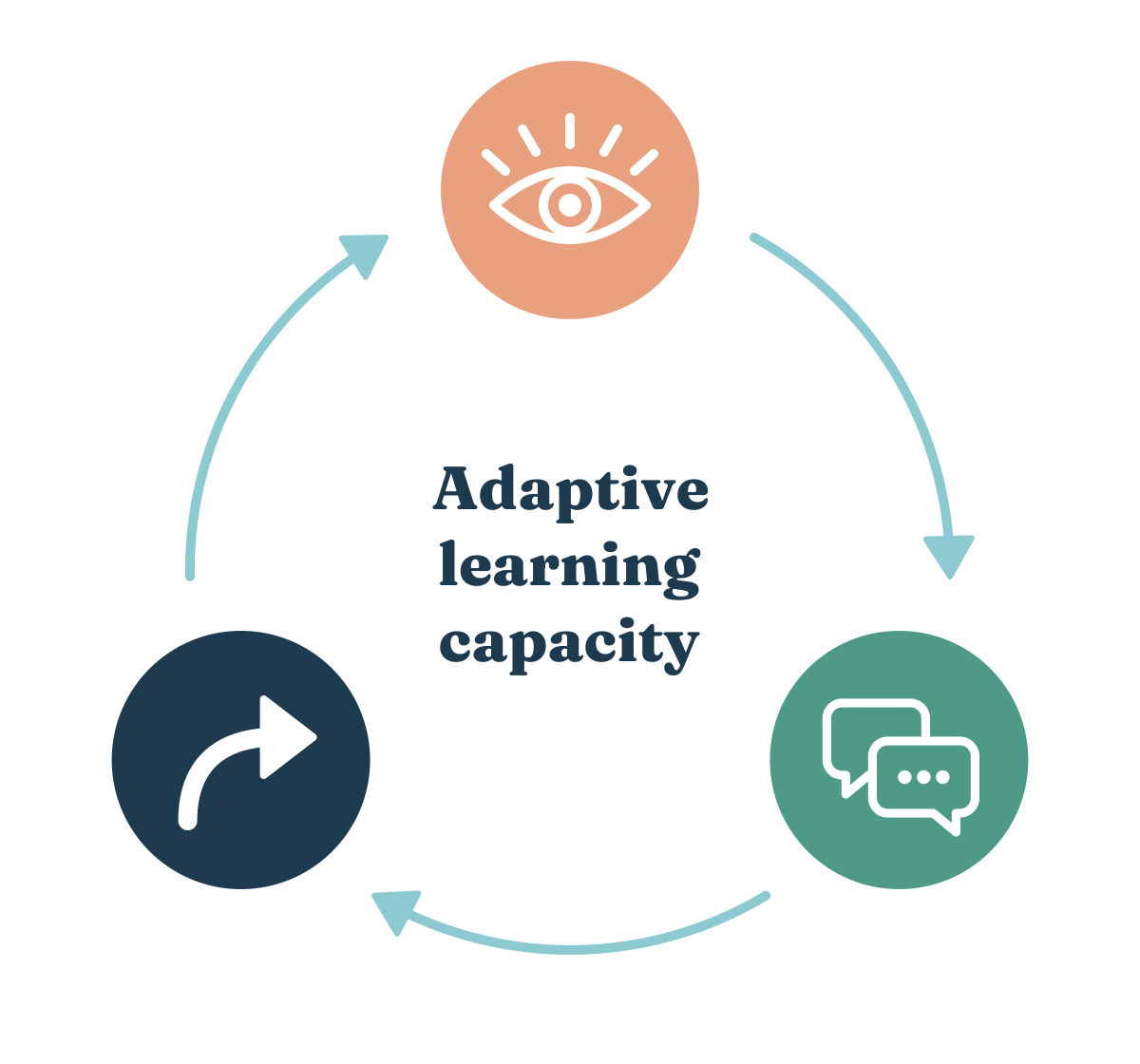
Adaptive learning capacity is an organization’s ability to notice what’s changing, make meaning of it together, and adapt its work with intention. A framework only matters if it strengthens that capacity. Here’s what that looked like for Merit and the FATE Program.
Noticing what matters, when it matters. The developmental strategy tells Merit what to pay attention to at each stage, rather than asking everything every year. New staff reflection forms capture what FATE program staff see between data points, often the earliest signals of what’s shifting for young people.
Making meaning together. Historically, Merit collected data and received analyses from outside consultants. The new framework gives Merit’s FATE team a structured way to bring numbers and stories together, compare what they see with what the theory of change expects, and decide what it means. Instead of asking mainly What did our students report this year?, FATE can now ask:
What should we be paying attention to at this stage of development?
What does the evidence across sources tell us about how young people are growing?
How does what we’re seeing compare with what we expected?
What should we do differently because of what we’re learning?
Adapting with intention. The framework is designed to change as Merit learns. When we recommended reconsidering whether focus groups needed to happen every year, Merit chose to keep them annually with updated protocols and revisit the question after seeing the new system in practice. That’s not a compromise. It’s the approach working as intended: make a thoughtful choice, learn from it, and adjust.
What Changed
Infrastructure to match the ambition
Merit’s ambition was always to understand growth across the full FATE journey. What changed is that it now has the infrastructure to do it, and is better positioned to tell a clear, credible story of growth to its board, funders, and community.
Before
- Annual snapshots, one year at a time
- Survey and focus group findings from separate consultants
- Tools not yet connected to the outcomes framework
- Findings received from outside
Now
- A connected picture across the 10-year journey
- Numbers and stories brought together
- Measurement matched to each developmental stage
- Meaning made by Merit’s own FATE team
The change also shows up in people. For Merit’s Program Success Director, who led the work day-to-day and came in focused on the tools themselves, the breadth of what emerged went beyond what she expected:
It was important to me that our evaluation continued to evolve to accurately assess the impact of the FATE Program, especially since we had recently developed a new outcomes framework that hadn’t yet been fully incorporated into our evaluation structure. We always envisioned a 10-year longitudinal arc for our work, and Laura shifted our perspective from viewing success through isolated annual snapshots to measuring holistic growth across developmental stages. She helped us build the framework and structure to support this vision – restructuring our tools into longitudinal surveys alongside annual pulse checks and introducing sensemaking sessions that turn data into ongoing program improvement. Working with Laura felt like a true thought partnership. She translated our staff’s insights into concrete frameworks that give us a shared language and a clear operational roadmap. For any organization looking to capture long-term participant growth, Laura helps you see the bigger picture and build evaluation systems you’ll actually put into practice.
She shared that she feels more confident implementing the new tools, and that the process expanded her thinking about feedback loops, sensemaking, and how evidence can be used across the organization. That kind of growth is what makes a framework last.
What Comes Next
From framework to living practice
Merit begins implementing the framework in the 2026-2027 FATE program year. Rather than introducing every new practice at once, the team will treat the first year as a chance to learn from the framework itself: testing the tools, starting new sensemaking and reporting rhythms, noticing what’s useful, and layering in more over time.
A stronger framework also raises honest questions about capacity: who will analyze the data, when the team will gather to make sense of it, and what outside support will help. Naming those questions early is part of making evaluation a living practice rather than a document on a shelf.
Merit already knew it wanted to understand the full story of young people’s growth. The work was building a system capable of seeing it, and a team ready to keep learning from it.
laura@illuminaryperspectives.com