

What Comes Into View
Exploring what becomes visible when we slow down enough to notice.
Welcome to What Comes Into View.
This is where I share observations, questions, and ideas emerging from my work with foundations, nonprofits, collaboratives, and community change efforts.
Much of the work we care about happens in conditions of uncertainty. We are often asked to make decisions before we have complete information, demonstrate impact before change has fully unfolded, and navigate complexity while simultaneously explaining it.
These essays explore what becomes visible when we slow down enough to pay attention.
Much of the writing below spans different phases of my thinking. While earlier posts focused more explicitly on evaluation and organizational learning, my current work increasingly explores complexity, uncertainty, strategic learning, and the questions that comes into view when we slow down enough to pay attention.
Want these reflections delivered to your inbox?
Subscribe to What Comes Into View, an occasional newsletter exploring learning, complexity, evaluation, strategy, and social change.

Adaptive Learning Capacity: Why Some Organizations Learn Faster Than Others
If you run a program, you probably know what it’s like to have a quarter that looks fine on paper while something in the back of your mind says otherwise. This series follows one organization from finding out by chance to finding out on purpose.

What happens when individual wisdom meets organizational learning? (Part 2)
This is the second half of a two-part exchange between Laura Richards, who works on organizational learning and adaptive capacity, and Laura Hartley, who works on individual transformation and coaching. Here, the questions turn to the harder mechanics: why doing the personal work doesn’t automatically change the organization around you, how an organization learns anything at all given it doesn’t have a brain to learn with, and what it actually takes in practice to build the capacity for wisdom to survive contact with a Tuesday.
Same format as part one: each question answered independently, then responded to across the individual/organizational divide.

What happens when individual wisdom meets organizational learning? (Part 1)
Laura H. would describe a client who’d done real, hard personal work and still felt swallowed by their organization within a month of walking back in the door. Laura R. would describe organizations that built entire learning systems that never actually changed how a room behaved. Same problem, different entry point.
So instead of resolving it into one tidy answer, we decided to write it out in the open - eight questions, each answered independently, then responded to across the individual/organizational divide. It ran long enough that we’re splitting it into two posts.
The first post covers the terrain: what uncertainty actually is, what a sane relationship to it looks like, where adaptive capacity lives, and whether an organization can be wise at all. Laura H. works from the inside out - the individual, the story someone’s carrying. Laura R. worked from the outside in - the room, the structure, the pattern an organization falls into without meaning to.

The One Sentence Missing From Most Strategic Plans
The world moves faster than strategic plans do. That doesn’t mean the plan failed. It means we’ve been asking it to predict the future, when its real job is to help us make better decisions under uncertainty.
The Questions That Lead to Better Decisions
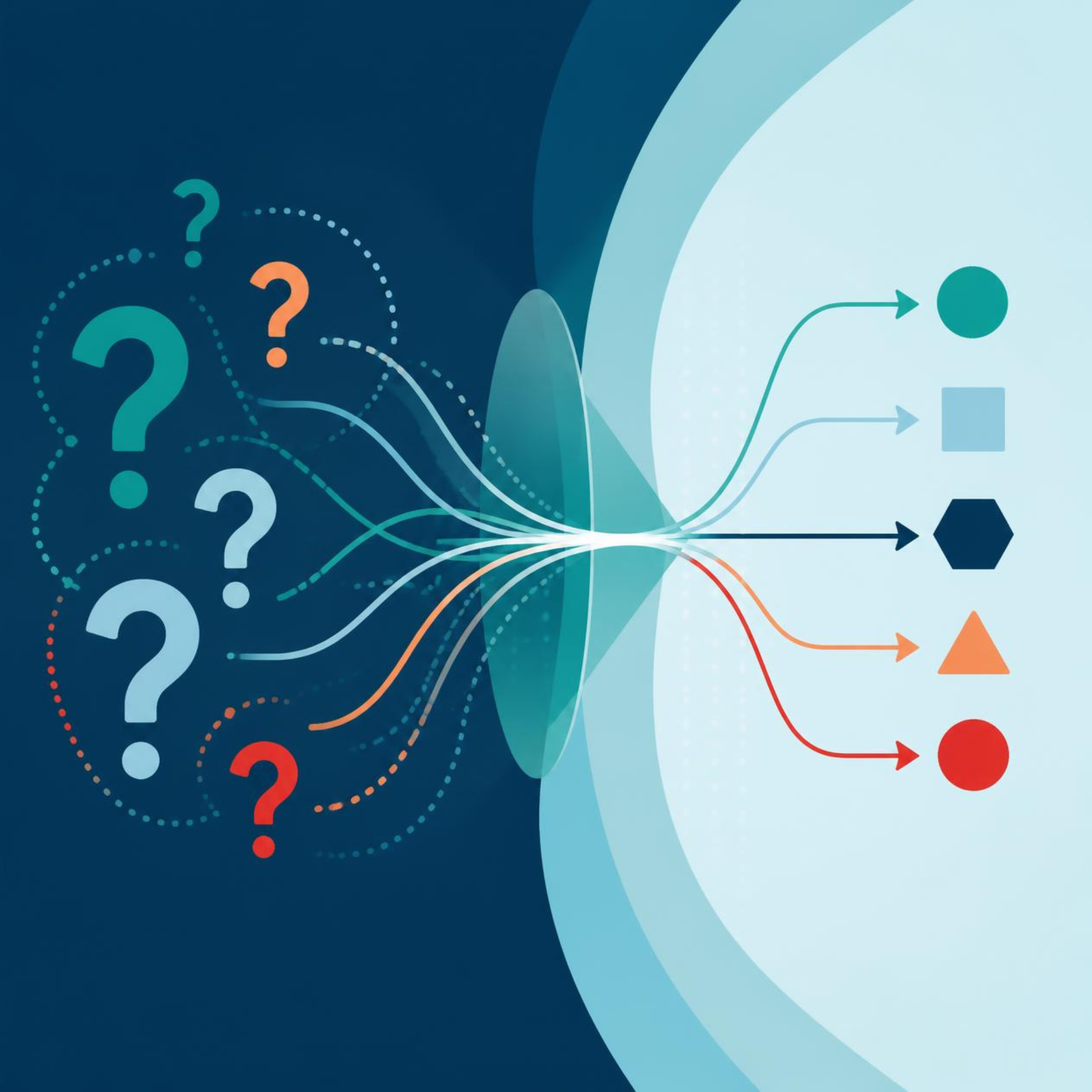
Organizations skip straight to what should we measure before they’ve clarified what we’re actually trying to learn. When that happens, evaluation quietly turns into an exercise in data collection instead of a practice of learning. When I ask “What are you hoping to learn?,” the answers are too broad to actually guide anything. So I ask: What decision are you trying to make? That’s when things get concrete. Suddenly the uncertainty has a shape and the conversation becomes useful. Better decisions don’t start with better metrics. They start with better questions.
How to Run a Rapid Learning Cycle: A Step-by-Step Guide
Many organizations today are working in environments where strategies evolve quickly, community needs shift, and new questions emerge faster than traditional evaluation timelines can answer them. By the time you’ve designed a study, collected six months of data, and written a report, the decision you were trying to inform has already been made. That doesn’t mean rigorous evaluation has become less important. It means there are moments when organizations need a different kind of learning alongside it. Rapid learning cycles are one way to do that.

The Capacity We’re Quietly Losing
The organizations that navigate uncertainty most effectively aren’t necessarily the ones with the most sophisticated strategic plans. They’re the ones that have built simple, consistent ways of noticing what’s changing, making sense of it together, and adjusting as they go. A few practices show up again and again among the organizations that manage this well.

Your Dashboard Can’t Tell You This: 8 things every nonprofit should be paying attention to
The most important conversations rarely begin with something on the dashboard. Instead, they start with observations that don’t fit neatly into a chart. None of these observations are metrics. Yet each of them may be telling you something important about what’s changing. That’s because dashboards are excellent at helping us understand what has already become visible. They are much less equipped to help us notice what is becoming visible.
So what should you actually be watching for? Here are eight things worth paying attention to alongside your metrics.

Who Carries the Uncertainty?
Uncertainty rarely disappears. It gets transferred. We create certainty for one group by asking another group to absorb it. When certainty becomes the goal, organizations become more focused on creating the appearance of predictability than building their capacity to learn and adapt.

A learning organization is a resilient organization
Purpose-driven organizations face challenges every day - from inside the organization and out in the community or system. That is why resiliency is a critical aspect to build in your organization. One of the often overlooked characteristics of a resilient organization is their emphasis on learning.